The dominant diminished scale, also known as the half whole scale, is an eight note scale with a numeric formula of 1-♭2-♯2-3-♯4-5-6-♭7-8/1. It is a symmetrical scale in that it follows a distinct pattern of steps, those being half step, whole step in a repeating pattern, not to be confused with the diminished scale which follows a whole step, half step pattern. The dominant diminished scale is also the second (and only) mode of the diminished scale (aka: whole half scale). There are really only two distinct dominant diminished scale patterns along with a third that covers most of the neck, this is due to the symmetry of the scale pattern. The first pattern has a sixth string tonic and the second has a fifth string tonic, the third pattern is an alternate that has an upward movement and has tonics on the fifth and sixth strings although in different keys.
As the dominant diminished scale contains eight notes, we have to repeat one degree when writing the numeric or notated formula to complete the scale, there are many ways of doing this, and no single way is either write nor wrong. Above and below I have repeated the second degree (one flat and one sharp) but you could also repeat the fifth degree or third degree.
The dominant diminished scale can be written in three keys (F, E and E♭) which will cover every other key. For instance: B dominant diminished is the same as F dominant diminished started on the fifth scale degree, and this is the same for G♯/A♭ and D diminished scales started on the third and seventh scale degrees respectively. Another way to look at it is to start from root position and move up in minor thirds which will produce the same result.
Harmonized dominant diminished scale
Tertian harmony is the harmonization of a scale moving up in thirds, whether that be major or minor. Secundal harmony is the harmonization of a scale moving up in seconds and Quartal harmony is moving up in fourths. Using strict Tertian harmony principals when harmonizing the dominant diminished scale (in other words using every second note in the scale for example: C-E-G) produces seven diminished triads and seven diminished seventh tetrads (aka: full diminished with a double flat seventh). Relaxing the rules and making use of Secundal and Quartal harmony opens up a plethora of chords as you are repeatedly given a choice of minor and major thirds, perfect fifths and flat fifths, and minor seventh degrees which is why one can harmonize such a large array of chords from one scale. There are no-less than twenty triads and twenty-five tetrads that can be built from the dominant diminished scale and below I have written them down for all three keys (F, E and E♭). Remember that the dominant diminished scale is the second (and only) mode of the diminished scale, and harmonization results are identical except raised a tone (or whole step). Take note of enharmonic notes and chords (example: C♯ is enharmonic to D♭ etc). If all you want is to view and learn the diminished scale patterns then just skip over this harmony section to the scale patterns below.
Dominant diminished scale profile
| Numeric formula | 1-♭2-♯2-3-♯4-5-6-♭7-8/1 |
|---|---|
| Notation formula (key of E) | E-F-G-A♭-B♭-B-C♯-D-E/1 |
| Notation formula (key of E♭) | E♭-E-F♯-G-A-B♭-C-D♭-E♭/1 |
| Notation formula (key of F) | F-F♯-G♯-A-B-C-D-E♭-F/1 |
| Stepping | half, whole, half, whole, half, whole, half, whole |
| Tonal | semitone, tone, semitone, tone, semitone, tone, semitone, tone |
| Harmonized triads (key of E) | E(♭5), E⁰, Emi, E / F⁰ / G(♭5), G⁰, Gmi, G / A♭⁰ / B♭(♭5), B♭⁰, B♭mi, B♭ / B⁰ / C♯(♭5), C♯⁰, C♯mi, C♯ / D⁰ |
| Harmonized triads (key of E♭) | E♭(♭5), E♭⁰, E♭mi, E♭ / E⁰ / F♯(♭5) F♯⁰, F♯mi, F♯ / G⁰ / A(♭5), A⁰, Ami, A / B♭⁰ / C(♭5), C⁰, Cmi, C / D♭⁰ |
| Harmonized triads (key of F) | F(♭5), F⁰, Fmi, F / F♯⁰ / G♯(♭5), G♯⁰, G♯mi, G♯ / A⁰ / B(♭5), B⁰, Bmi, B / C⁰ / D(♭5), D⁰, Dmi, D / E♭⁰ |
| Harmonized tetrads (key of E) | Emi7(♭5), E⁰7, Emi7, E7, E7(♭5) / F⁰7 / Gmi7(♭5), G⁰7, Gmi7, G7, G7(♭5) / A♭⁰7 / B♭mi7(♭5), B♭⁰7, B♭mi7, B♭7, B♭7(♭5) / B⁰7 / C♯mi7(♭5), C♯⁰7, C♯mi7, C♯7, C♯7(♭5) / D⁰7 |
| Harmonized tetrads (key of E♭) | E♭mi7(♭5), E♭⁰7, E♭mi7, E♭7, E♭7(♭5) / E⁰7 / F♯mi7(♭5), F♯⁰7, F♯mi7, F♯7, F♯7(♭5) / G⁰7 / Ami7(♭5), A⁰7, Ami7, A7, A7(♭5) / B♭⁰7 / Cmi7(♭5), C⁰7, Cmi7, C7, C7(♭5) / D♭⁰7 |
| Harmonized tetrads (key of F) | Fmi7(♭5), F⁰7, Fmi7, F7, F7(♭5) / F♯⁰7 / G♯mi7(♭5), G♯⁰7, G♯mi7, G♯7, G♯7(♭5) / A⁰7 / Bmi7(♭5), B⁰7, Bmi7, B7, B7(♭5) / C⁰7 / Dmi7(♭5), D⁰7, Dmi7, D7, D7(♭5) / E♭⁰7 |
Dominant diminished scale patterns
- Sixth string tonic
- Fifth string tonic
- Fifth & sixth string tonics
- Help
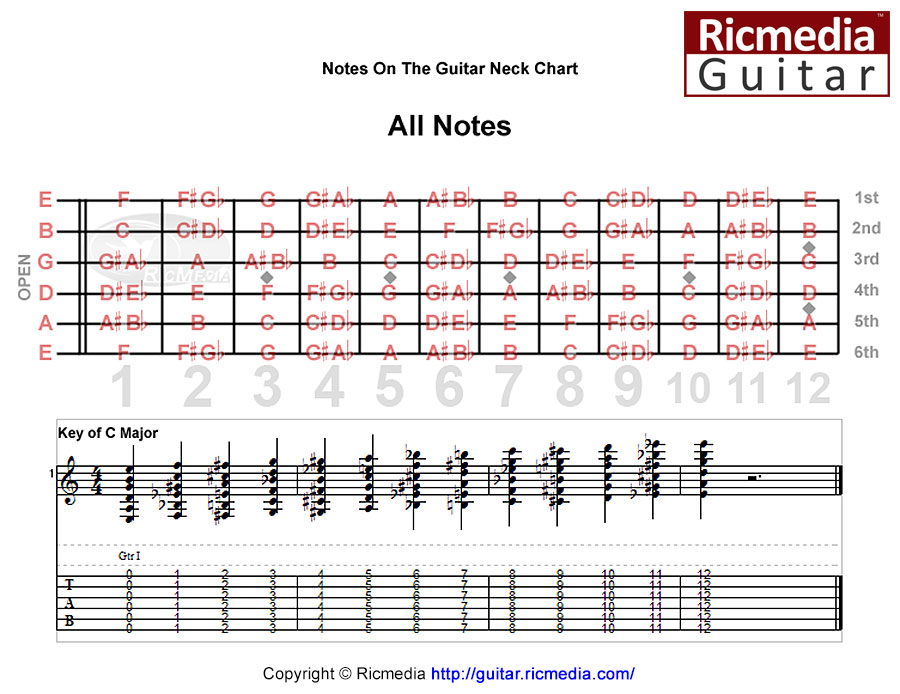
- Guitar Neck Notes
- Octave Chart



Dominant diminished scale audio sample(s)
| Dominant diminished scale alternate pattern |
|---|
Leave a Reply