Today's theory lesson will revolve around rhythm notation, and follows on from the previous lesson on Pitch notation.
Contents
What is rhythm?
Rhythm is everywhere. It is in our speech, in our walk and run, it's when we type or make a call and even our heartbeat, it is intrinsic to our nature. In fact, Neurologist Oliver Sacks posits that human affinity for rhythm is fundamental, so much that a persons' sense of rhythm cannot be lost in the way that music and language can (e.g. by stroke). (cited from Wikipedia.org). So we all have an innate (natural) sense of rhythm that can be expanded into the musical arena, it just takes time and practice, never let anyone tell you that you don't have rhythm!
These everyday rhythms do not require one to communicate them via written media however, in music, we do need a system of writing and communicating rhythm that can be understood by other musicians. The system that has evolved over many hundreds/thousands of years is musical notation, which is a set of symbols that can accurately describe any type of rhythm, as well as pitch, but we will be focusing on the rhythm part in this lesson. Musical notation describes the duration and timing of beats, with the addition of multiplier symbols like dots and ties. Let's now begin learning the symbols of rhythm notation.
Rhythm notation
Below you will find a chart that shows the division of note length values starting with the whole note (semibreve). Firstly, in order to perform division, we need a divisor, and it seems the humble quarter note (crotchet) has been given this title. What this means is that note values are relative to the quarter note. For instance: a whole note has the value of four quarter notes. As another example: a half note (minim) has the value of two quarter notes.
Looking at the chart below, you will find notes ranging from the whole note, right through to the not so common sixty-fourth note. Because 4/4 timing is so common, it is used as the default for all musical notation values. The sixteenth note gets its name because one bar in 4/4 timing can contain sixteen, sixteenth notes. The same is true for thirty-second notes, for every bar in 4/4 timing there can be thirty two, thirty-second notes. Going the other way, one bar in 4/4 timing can contain two half notes, or one whole note, or four quarter notes. Can you see a picture emerging? How many eighth notes could there be in one bar in 4/4 timing? Well the answer is, surprise surprise….eight

So musical notation is really basic mathematics. Remember in the lesson pitch & rhythm we had the addition examples? Well here it is again but this time we want all the notes to add up to one whole note (or four quarter notes) because we are in 4/4 timing, which is four beats per bar, and each beat has the value of one quarter note.
| 4/4 Timing addition examples | |||
|---|---|---|---|
| Notes | Equals | Result | Comments |
 + + + +  + + + +
|
= |  |
Two eighth notes plus three quarter notes equals one whole note |
| + + + + +
|
= | |
Four eighth notes plus two quarter notes equals one whole note |
 + + + +
|
= | |
One half note plus two quarter notes equals one whole note |
| +
|
= | |
Two half notes equals one whole note |
 + + + + + + + + + +
|
= | |
Four sixteenth notes plus one quarter note plus one half note equals one whole note |
Rhythm examples
Let's now start to explore reading rhythms in the charts below, keeping in mind they are all in 4/4 timing.
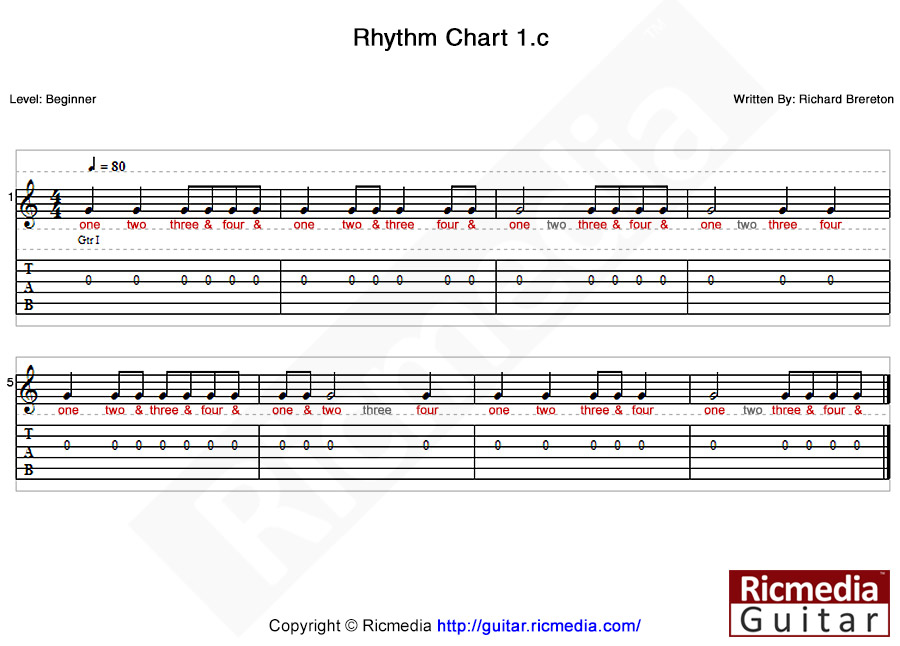
When reading rhythms, it is sometimes helpful to use a counting method. The red writing below each note can help you understand how a given rhythm is meant to sound. Basically, each syllable gets a beat, so one two three four is four beats, and one & two & is four beats in half the time as the previous example, and is used for eighth note rhythms. Before you try to play these rhythms, be sure to listen to the audio examples further below and play along with them as this will ease you into it.
Rhythm chart 1.a
Starting with rhythm chart 1.a which is pretty straight forward but be careful with bars seven and eight. Start by counting in four beats, one, two, three, four… and play the open G on the third string, and keep an even rhythm. If you get stuck, have another listen to the audio examples below.
Rhythm chart 1.b
Next onto chart 1.b which introduces eighth notes into the mix, this chart may take longer as it’s more complex than the previous. Watch out for the last bar (bar eight) and use the counting method in red below the notes.
Rhythm chart 1.c
Now onto the last chart 1.c which explores some more complex rhythms, remember, if you get stuck just listen to the audio below, and watch out for bars five and six.


| Rhythm chart 1.a | |
|---|---|
| Rhythm chart 1.b | |
| Rhythm chart 1.c |
Summary
So how did you go? Rhythm can be hard and frustrating sometimes, but keep coming back and persist, it will be worth it. Be sure to follow on to the next lesson: Rest notation.
Cheers & enjoy!
Leave a Reply