A major arpeggio is a three note broken chord with a numerical formula of T/1-3-5 played as individual notes in sequence, the same as you would play a scale. For guitarists, arpeggios are an integral part of guitar soloing, picking and dexterity exercises, as well as helping the player to have a fuller understanding of melody.
Arpeggio Usage
As an arpeggio is essentially a chord played as individual notes (hence the term "broken chord"), a lead guitarist can construct a melody following the chords that the rhythm guitarist is playing with little fear of hitting a bad note, resulting in a melody that is generally, very harmonious. Arpeggios are also very useful when constructing sweep picking phrases in solos as the patterns tend to have one note on each adjacent string (with the occasional two notes per string depending on the pattern) which lends itself very nicely to sweep picking. Arpeggios are also excellent dexterity and coordination exercises and most good guitar teachers will use them in their curriculum.
About Arpeggio Pattern Numbering
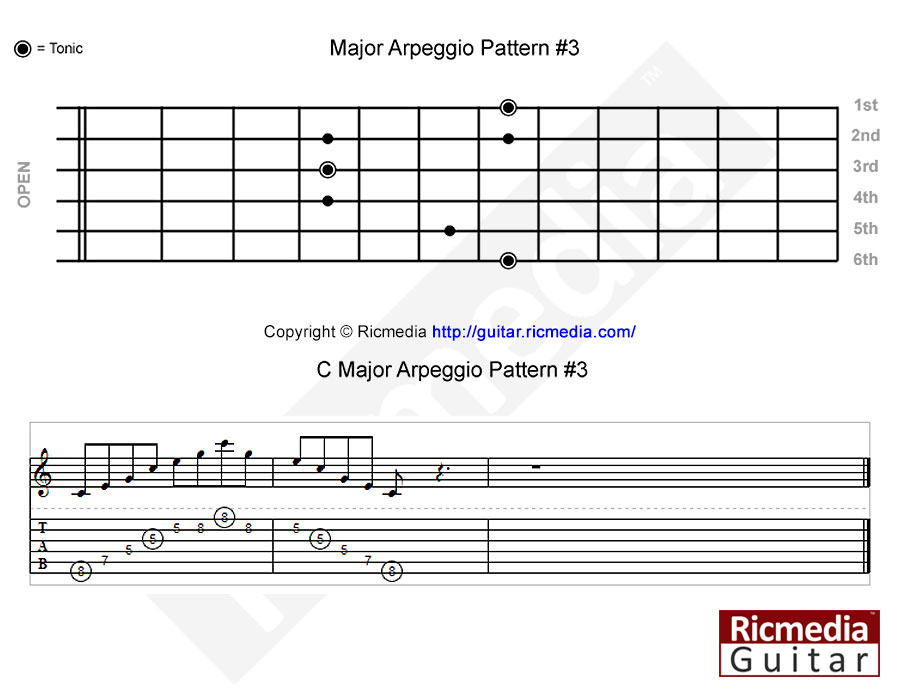
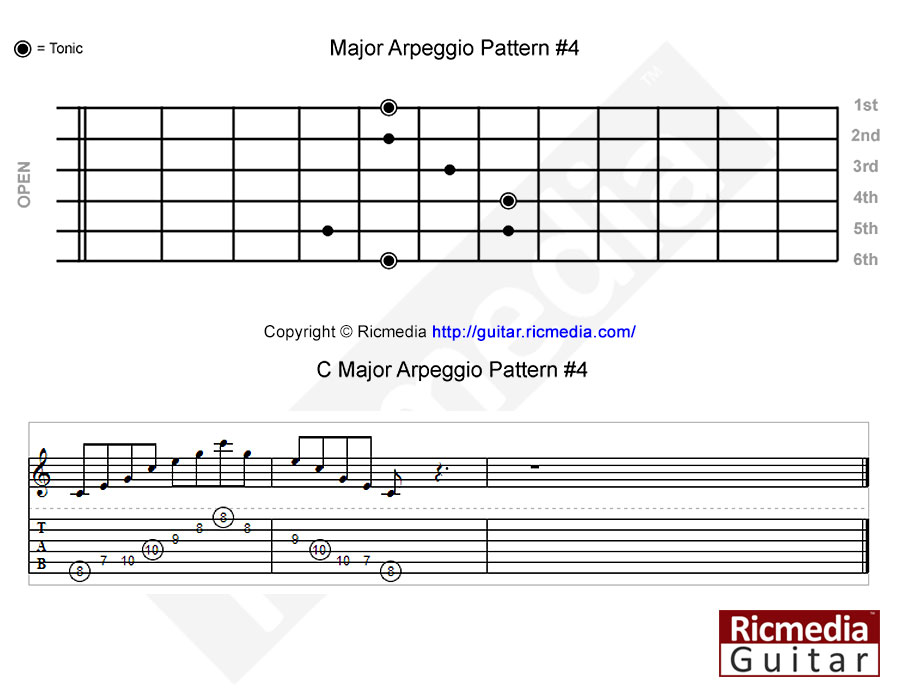
The major arpeggio patterns below are referenced as numbers #1, #2, #3, #4 and #5 which you will find correspond directly with the chord voicings, scale patterns and reading positions of the same number, for instance: major arpeggio pattern #4 is built from major chord voicing #4 which is built from major scale pattern #4 and all belong to reading position #4. The five positions cover the entire neck which gives us a structure to memorize scales, arpeggios and chords.
Major arpeggio profile
| Numeric formula | 1-3-5-8/1 |
|---|---|
| Notation formula (key of C) | C-E-G-C/1 |
| Stability | Consonant, resolved |
Major arpeggio patterns





Major arpeggio audio sample(s)
| C Major arpeggio pattern #4 |
|---|
Leave a Reply